Source & Summit
Nov 6, 2025
Advent is a season of new beginnings—of hope, of expectation, and of renewal. It’s also an opportune time for parishes to deepen and renew their sung prayer, especially by exploring the riches of the antiphons of the Mass—even for the first time
The Second Vatican Council called the sacred music tradition “a treasure of inestimable value, greater even than that of any other art” (SC 112). Yet this treasure has often remained buried. But pastors and musicians everywhere are discovering it anew and beginning to implement what the Church has always given us as an integral part of the sung liturgy: the antiphons—the appointed texts for the Entrance, Offertory, and Communion processions.
These brief scriptural chants do more than fill silence; they are the words of the Mass itself. They put the Word of God on the lips and in the hearts of the faithful and express an essential part of the mystery of each celebration. When they are sung, along with the other parts of the sung liturgy, our earthly celebrations more clearly prefigure the liturgy of the Heavenly Jerusalem.
Despite this lofty vision the Church presents to us, implementing antiphons need not be overwhelming.
The Church provides immense pastoral tools that allow for a gradual introduction, leading toward a greater participation in the fullness of the sung liturgy over time.
This Advent, consider taking the next step.
Here are three practical, pastoral ways to begin introducing antiphons in your parish.
1. Start with the Communion Antiphon
The Communion Antiphon is often the easiest and most natural starting point for parishes introducing sung propers for the first time. It requires no massive interruption to the ordinary experience of most parishes today, and can easily be sung in addition to a familiar communion hymn. It accompanies one of the most intimate and contemplative moments of the Mass, when the faithful process forward to receive the Body and Blood of Christ.
The Communion antiphon beautifully unites the Liturgy of the Word and the Liturgy of the Eucharist. It often echoes the themes or even the very words of the day’s Gospel, helping the faithful make a deeper connection between hearing Christ in Scripture and receiving him in the Eucharist.
The General Instruction of the Roman Missal states that the Communion Chant begins “while the priest is receiving the Sacrament and continue[s] for as long as Communion is distributed.” It can therefore be sung even once by a cantor, and then be followed by a hymn, or many times by the congregation in alternation with Psalm verses sung by the cantor or choir, much like a Responsorial Psalm. This antiphon offers tremendous flexibility, making it a fitting first step for parishes first introducing sung antiphons.
There is also a pastoral wisdom in beginning small. When the Communion Antiphon is sung weekly, even with a single verse or Glory Be, it introduces a consistent pattern of sacred song that parishioners quickly internalize. Over time, this repetition forms both habit and memory: what begins as unfamiliar soon becomes second nature.
In this way, the parish learns through doing. Mystagogical catechesis can then invite the faithful more deeply into the meaning of the mystery over time.
When the Church sings the words of the liturgy, even in the simplest way, we unite ourselves to the prayer of the logos, the Eternal Word, who is continually offering the perfect song of praise to the Father for the salvation of the world through his Mystical Body on earth. The Communion Antiphon opens the door to a new way of singing and praying with music in the liturgy, beyond what mere devotional music can offer.
2. Pair Antiphons with Hymns: The Wisdom of Pastoral Continuity
Many parishes hesitate to introduce antiphons because hymns have long provided a familiar vehicle for congregational singing. Choirs, cantors, and congregations alike often know them by heart. The key to effective renewal, however, is not abrupt replacement but patient continuity. Pastorally sensitive implementation is more successful when new practices take root through gentle integration rather than sudden reform.
Therefore, one of the most effective ways to begin is to pair antiphons with hymns during the Mass processions. This approach allows the liturgy’s proper texts to enter parish life without displacing the repertoire that people already know.
This is a natural, pastoral step: rather than having one form suddenly replace the other, the two can coexist for a time, allowing the antiphons to find their place through repetition and familiarity, and eventually replace the hymn entirely.
Practically, this can take several forms:
At the Entrance: Sing the Entrance Antiphon after an opening hymn, especially during the incensation of the altar. This allows the antiphon to introduce the liturgy’s theme while keeping a congregational hymn.
At the Offertory: When the faithful are less likely to sing robustly, the antiphon may be sung by a cantor or choir before a hymn.
At Communion: Begin with the Communion Antiphon—optimally with a Psalm verse or two—then continue with a familiar hymn for the congregation. Alternatively, the Communion Antiphon can even cover the entire reception of Communion and be followed by a Hymn of Praise, following the provision in GIRM 88.
These small adjustments will help the parish hear and sing the Church’s own sung texts at moments when hymns and songs from outside of the Mass are ordinarily sung. They also teach by experience. Parishioners begin to recognize that these scriptural refrains are integral the liturgy itself—the texts given by the Church for each celebration intended for their spiritual benefit.
Pairing hymns and antiphons also helps resolve a deeper pastoral tension. Many parish musicians sense the pull between liturgical fidelity and the practical realities of parish life. This method honors both. It builds upon what is already familiar while gradually enabling a fuller expression of the Mass as it is given in the liturgical books. Over time, the antiphons will come to feel less like additions and more like anchors—brief, luminous moments that shed light on the liturgy as a whole.
When approached this way, the shift toward sung propers feels less like a disruption and more like a natural deepening. Step by step, this continuity offers an accessible point of entry into the heights of the Church’s sung prayer.
3. Introduce Antiphons Seasonally
For many parishes, the idea of introducing three new proper antiphons every week can seem impossible. Choirs may already be stretched thin, and assemblies may struggle to learn entirely new music from one Sunday to the next.
There’s a practical solution: begin seasonally.
As a pastoral tool, parishes can select one or more antiphons from each liturgical season and sing them several times throughout that season rather than trying to manage every Sunday’s set of proper texts. This approach is both sustainable and catechetical, allowing the faithful the time they need to learn them well and pray with them deeply.
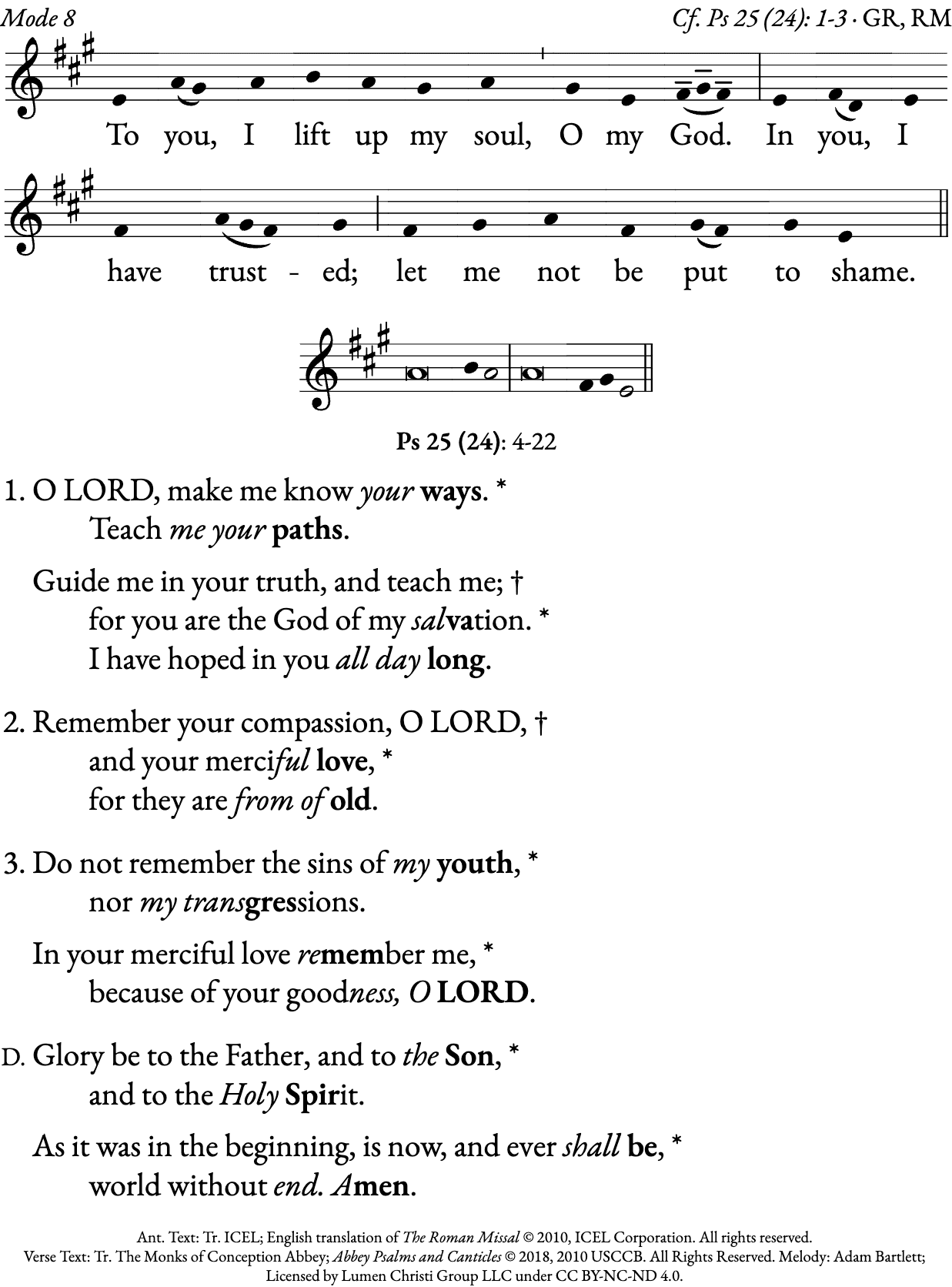
This method is supported by the introduction to the Ordo Cantus Missae, which states that, “for pastoral reasons, the text proper to a day may be replaced with another belonging to the same season.” In practice, this means that a parish might choose one Advent Entrance Antiphon to use throughout the four weeks of the season—perhaps To you I lift up my soul from the First Sunday of Advent—and then move to a seasonal Christmas antiphon when the Christmas season arrives.
Seasonal introduction also respects the learning curve of both choir and congregation. Many antiphons are actually easier to sing than many contemporary hymns, and once their style is internalized, new antiphons can be learned quickly. As the antiphons become familiar, they begin to shape the parish’s musical identity—rooting it more deeply in Scripture, in the rhythm of the liturgical year, and in the song of the liturgy itself.
By introducing antiphons seasonally, parishes not only make the transition manageable—they rediscover the beauty of liturgical repetition: a sound that returns year after year, forming hearts to pray with the Church’s own voice.
A Call to Begin
The sung liturgy is not some unattainable ideal—it is the Church’s normal form of worship. Every parish can begin implementing it, one step at a time. And Advent is the perfect time to start.
What matters most is consistency, not perfection.
The Church’s chant tradition is not meant only for experts—it also belongs to every parish and every voice.
Begin this Advent. Let the antiphons lead your community into deeper prayer and unity. Explore practical tools and digital resources in the Source & Summit Digital Platform, and help your parish truly sing the Mass, and not merely sing at Mass.