Source & Summit
Apr 20, 2026
There’s been a renewed attention to beauty in the life of the Church in recent years, especially in the way we approach the liturgy. This renewal isn’t about novelty, but about rediscovering what has always been true: that the liturgy calls for forms set apart—capable of revealing the invisible heavenly realities that they signify. That renewed attention to beauty extends beyond liturgical music, of course, and also into the realms of visual, sacred art and architecture.
Few artists today are contributing more thoughtfully to the renewal of sacred art than Ruth Stricklin of New Jerusalem Studios. Her work will be familiar to many through the Source & Summit Missal—Ruth's beautiful cover art has become a key aspect of our project’s identity.
Ruth’s work is now reaching an even wider audience through her involvement in the forthcoming editions of the Liturgy of the Hours from Ascension Press. That project, much like the presence of beautiful sacred art in parish pews, will quietly shape the prayer and sacramental imagination of the Church within the United States for decades to come.
Peter Gohn with Source & Summit recently connected with Ruth to reflect on her role as a sacred artist, the importance of beauty in liturgical renewal, and the principles guiding her work today. We hope you find the conversation edifying.
The Goal & Vision for Sacred Art
Peter Gohn: Ruth, it’s a gift to have you with us. To begin, we’d love to ground the conversation in your own story and vision. Your work clearly operates within a deeply theological vision of art. How would you describe your vocation as a liturgical artist?
Ruth Stricklin: I discovered my vocation as a sacred artist after my own conversion experience, when I was asked to paint an altar mural backdrop for a Catholic high school, Xavier College Prep, in Phoenix, Arizona. Coming from an evangelical background, I never knew what awaited me in the richness of the Catholic faith—in the glorious art and architecture, the profound theology, the sacraments, and most especially, in the Eucharist. It all slowly unfolded as I worked on the scene from Revelation of the Wedding Feast of the Lamb. Under the guidance of the chaplain, Fr. John Muir, I was able to discover that Christ offers his very self to us in every Mass. Not figuratively or symbolically, but actually. It’s astounding. This mystery was revealed to me through an encounter with the beauty of sacred art—and it forever changed me and gave me a new hope.
I want to reveal this truth, this heavenly reality, through my own work so others might encounter Christ and come to know him.
While studying at the Liturgical Institute at Mundelein Seminary, I read St. John Paul the Great’s Letter to Artists for the first time. In it, he reveals Beauty as a vocation in itself. I cried when I read this; it resonated so deeply with my lifelong pursuit of beauty, all the while not recognizing that it was really a pursuit of Christ. A vocation is a life purpose, a calling to serve Christ’s mission on earth in a particular way. I discovered that the things I always loved—beauty in art and craft, music, nature—all of these served God in his mission to redeem the world. I felt I had finally found something I had been longing for and missing, and it brought a wholeness and purpose to my life. What an incredible gift!
PG: What a gift, indeed! Many of us here at Source & Summit can describe similar personal moments when it comes to music.
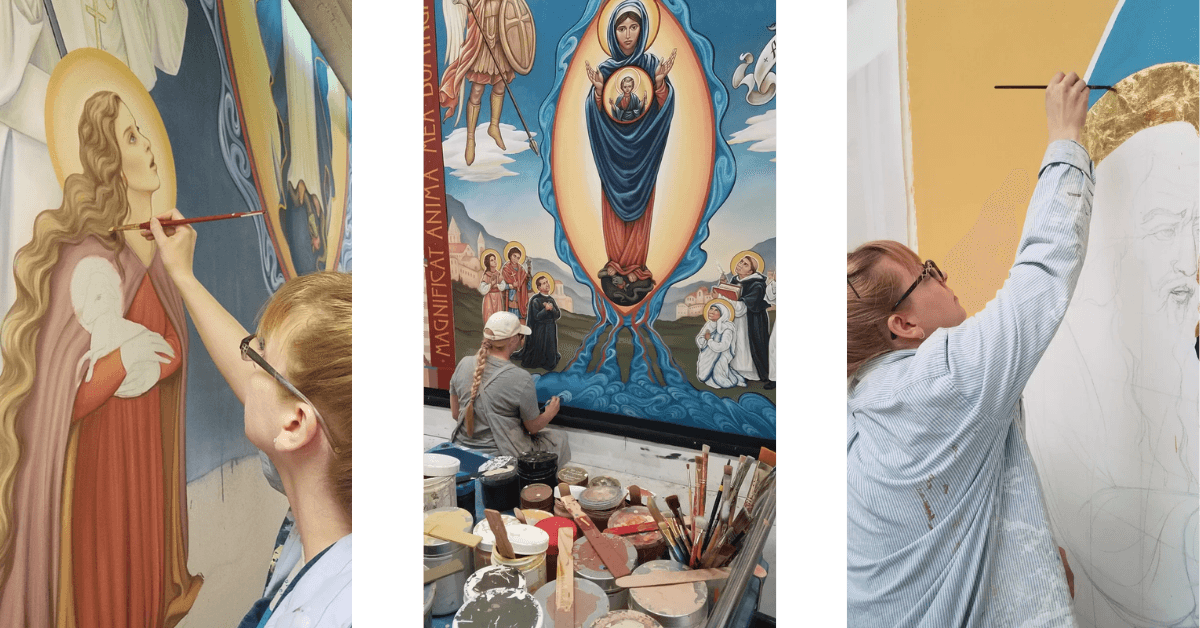
(The artist at work. Photos courtesy of New Jerusalem Studios)
Now, in our work at Source & Summit, we always keep in mind the distinction between devotional music and true liturgical music, which is an integral part of the liturgy itself. When it comes to visual media, what distinguishes liturgical or sacred art from religious art more broadly, and how does that difference impact your work?
RS: This is a topic I encounter frequently. I would respectfully suggest that there seems to be a confusion of terms, even among the faithful. Many different styles and genres of art fit within the category of Religious Art. But there can be further classifications within that structure to help us decide what is appropriate for certain uses. Devotional images are useful for private or communal prayer outside of the liturgy. This is good and necessary to grow our faith. Even art genres such as expressionism can be a type of prayer to God, useful for personal exploration and therapeutic processes, and could be considered Religious Art if this was the inspiration and intention. In her official teachings, the Church also tells us that the devotions are a way to prepare us for Christ’s action in the liturgy. So there is an integral relationship between devotional prayer and liturgy.
As I hinted at just above, sacred art is something unique. The word “sacred” originates from the Latin "sacrare," meaning to set apart or consecrate for worship. We have sacred objects—vessels, vestments, furnishings, buildings—and sacred music, all of which are created for and reserved exclusively for one purpose, the liturgy. Over the millennia, the Church has developed music and art that is set apart from that of the world, specifically to serve the action of the liturgy. It sounds different, it looks different, because its ultimate end is profoundly different—to reveal the heavenly banquet, the eternal sacrifice of Christ to the Father, integrating the entirety of creation and the Mystical Body of Christ. Its purpose is not to entertain, but to reveal our present celebration of this glorious event and our ultimate end, when we are fully restored and united to Christ in heaven.
The Second Vatican Council clarified that the purpose of the liturgy is the glorification of God and the sanctification of man (See Sacrosanctum Concilium §10). Sacred art, which serves the liturgy, does this through specific principles. It must be beautiful—a radiant expression of the true and the good. It must be clear and legible, so the truth can be revealed and not hidden or distorted. It must be in proper proportion to its noble purpose, yet also not overwhelm the action of the liturgy, which is primary. “It must be naturalistic enough to be legible, abstracted enough to be universal, and divinely idealized enough to be eschatological, “ to quote Denis McNamara, from Catholic Church Architecture and the Spirit of the Liturgy. These are a few examples of the parameters that guide the sacred artist. Sacred art shares many such principles with sacred music and church architecture.
On a more personal note, sacred art should be a visual revelation of the Glory of God—not the glory of the artist. The artist must cast aside any need to be praised, recognized, or personally understood. Attempts at self-expression or manipulating the emotion of the viewer through the artwork are not useful, and they can even hinder the work of the Holy Spirit.
The high calling of the sacred artist is to reveal the intelligence, grandeur, and proper praise of the Almighty so the viewer can encounter the Love of God and be transformed. Images of the saints must show their lives glorified and restored in God, no longer subject to the Fall. The style, subject matter, and composition of the work must be elevated beyond the everyday. It must remind us of our littleness and our need for redemption, but also of how we are infinitely loved and have been given the promise of heaven.
It should call us to conversion, but also be so radiantly beautiful that it gives us joy and enthuses us for the hard work of this conversion process.
PG: That joy and inner sustenance for conversion actually touches on our next question: when people encounter one of your pieces—whether that be someone walking into a church where your work adorns the sanctuary or the priest who will open his breviary—what do you hope is happening interiorly?
RS: My hope is that my work would allow people to encounter the love of God, the perfect order of his mind, which invites us into healing and integration with this divine order, and to call them into their own participation in his mission to redeem the world. I pray through my work that the Holy Spirit would be present to people in a new way each time they encounter it.
Sacred art not only depicts the glorious and profound moments in salvation history. It also reveals the rich symbolism and typology of these moments and how they are connected to parallel events and people of the past, revealing a deeper truth and greater plan of salvation. My hope is that the viewer might draw new connections and experience God’s love and goodness, realizing that we can enter into these mystical events and find hope for our own lives—our own Exodus, our own Passover, our own Resurrection in Christ.
PG: Earlier, you mentioned Denis McNamara and Pope St. John Paul II as particular influences in your formation. Are there any other particular liturgical books, pieces of Sacred Scripture, or spiritual writing that you often return to to inform your work?
RS: Catholic Church Architecture and the Spirit of the Liturgy by Dr. Denis McNamara was my introduction into the sacramental principles of beauty and how they are applied to art and architecture. It was life-changing to discover it, and I constantly return to it as a reference. It should be in every priest’s library as a guide for church renovation or construction projects!
The Way of Beauty by David Clayton is another fundamental work that is a playbook for sacred artists, not only laying out the principles of Beauty, but restoring and refocusing the heart of the artists in a world turned upside down by relativism. I buy copies of these for my interns, and they are amazed within the first chapter.
Interior Freedom by Fr. Jacques Philippe is my spiritual go-to, reminding me that true freedom comes from surrendering my whole being to God and trusting in his goodness.
PG: And what about other art? Is there a particular piece of sacred art that has deeply influenced you?
RS: I have several favorite works that I have returned to over the years for study and inspiration—Christ Pantocrator at St. Catherine’s Monastery in Sinai, Egypt. This work is filled with theological meaning and symbolism that always inspires. I love the works of Fra Angelico and the medieval Gothic cathedrals, such as the Basilica of St. Francis in Assisi, for their balance of glorious beauty and emotional restraint. And I have learned so much from the Beuronese style of art—my favorite example being the Crypt chapel at Montecassino, Italy. It is resplendent, but beautifully ordered and tasteful.
The Role of Beauty in Liturgical Renewal
PG: Let’s turn our attention now to the broader cultural moment. We’re seeing a renewed attention to beauty across the Church within art, architecture, and music, as well as in liturgical books. From your perspective, what is driving this moment of renewal?
RS: For many decades, perhaps even hundreds of years since the ironically named “Enlightenment”, our culture has been moving away from the good, true, and beautiful as being an expression of God, toward a secular or subjective ideation. One’s own desires and inclinations are mistakenly seen to be the basis for truth. Goodness is whatever makes us feel pleasure. And “beauty” is anything that attracts us or captures our attention.
As a culture and as a people, I believe we are fatigued. Because we are made in the image and likeness of God, we deeply sense that we are not the center of reality, and to say that we each define truth distorts our very identity. It causes great angst to carry the burden that “I determine reality”. Whether we are aware of it or not, we long for connection to God and a return to the Garden of Eden. We long for boundaries. Boundaries communicate love. We naturally sense that there are objective boundaries, a moral law, and principles by which we should live. We have learned that ultimate, unbridled freedom causes unhappiness, and for many, our souls are nudging us to return to order, to return to love, to rest in the peace of truth.
Young people seem especially open to the power of beauty. I have seen them transfixed by hearing Gregorian chant for the first time, or when they first encounter a sacred art mural. We were created for mystery, meaning, the poetry of symbol, and we are starved for these in a world of instant but shallow gratification, overwhelmed by an onslaught of noise and junk imagery designed to grab at our senses, and then be discarded.
When someone who has lived on crumbs their entire lives discovers a banquet, no one has to convince them to eat. It’s a natural response.
PG: Following that renewal—and the deep hunger you’ve described—how do you see sacred art actually forming the faithful, both spiritually and in the imagination?
RS: Sacred art, like the liturgy itself, invites people to encounter the true and the good—the love of God. When we encounter this, we can respond, and with the help of the Holy Spirit, be transformed. Participating in the liturgy makes us into heavenly beings so we can be united to God for eternity. Sacred art assists in this process by revealing our eternal hope and destiny.
We are sensory beings, and when we engage all of our senses, along with our emotions and imagination, but then submit it all to the Father along with the entire Mystical Body, it is then that we can be restored, integrated, and healed.
This may happen slowly, but there may also be moments of profound revelation and encounter that are instantly life-changing. I have heard accounts of people praying in front of a sacred artwork and suddenly experiencing the grace of God pouring over them. I have also heard some people reject sacred art and the beauty they encounter.
If something is truly beautiful, it reveals the good and the true, and this can conflict with a heart that is not disposed to goodness and truth. In this case, the fault is not with the artwork but rather with the distorted heart. In this way, sacred art and beauty in general can challenge us and help move us toward conversion and transformation. It is much like poetry—not meant for immediate consumption, but for contemplation.
If a work is challenging, pray with it, sit and contemplate your own heart, and it might have something to show you.
The Craft: Process, Constraints, and Media
PG: We would love to spend a bit of time asking about your own craft, process, and your ongoing work on the Liturgy of the Hours with Ascension Press.
Your work for the Source & Summit Missal has always involved a very intentional use of line, contrast, and negative space. Some of that is, of course, due to the particular medium and limitations of a missal cover. How do constraints like format, printing method, or material shape your artistic decisions?
RS: My experience with the Source & Summit Missal has been very rewarding and a tremendous educational experience for me. I began my sacred art vocation working on large, colorful murals. When I was asked to create simple “woodcut-style” images for the missal covers, which are stamped in gold foil, it required a complete shift in my artistic framework.
For this particular process, I am limited to only high-contrast black and white. When I would usually have color, line, and gradients of shade to help distinguish between elements, in this case, I only have light and the absence of light. I consider the cover color of each edition to function as the shadow or negative space in the image. Any element that I want to come forward must be in gold foil. This has really changed how I see light and shadow in a work, and has refined my use of contrast. Every line must have a purpose, which strips everything down to the essentials.
I also have to use great restraint with detail so as not to add visual fussiness to the image. The final result is very focused and purposeful, which has helped all of my other art improve.
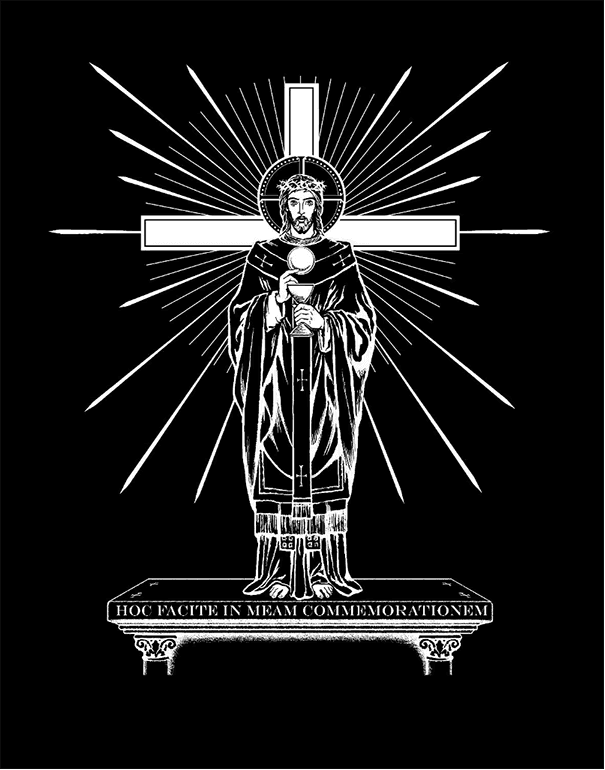
(An example of Ruth's line-art work: Cover Art for the Source & Summit Missal 2022-23)
PG: You’ve spoken about the importance of hand-drawn work in preserving a sense of life and dynamism. What is lost—or gained—when sacred art becomes fully digital?
RS: We live in a new era of digital tools and the growing influence and assimilation of AI. A great transition is happening, and we are coming to terms with what is gained and lost by employing these devices, especially in our creative spaces. As a human and an artist, I am a part of God’s creative expression, and I know that the Holy Spirit works in and through me. AI is a tool of God-given human creativity, but it has no spirit in it, no breath of life, no likeness of God. At best, it can only regurgitate what it has been fed or “trained on.” From what I understand, it even captures AI-generated images to train on, which is a very strange, self-repeating loop that will eventually lead to deterioration. Human creative expression, by contrast, has the potential to be expansive because we come from an uncontainable, eternal Creator.
When well-meaning laypeople, priests, or parishes put AI-rendered religious art out there, the intent is probably good, but misapplied. If we really think about what we are creating and sending into a world starving for authentic encounter, providing works that are AI-generated only adds to the deficiency and malnourishment of culture. Whereas, there are many artists out there who can bring new works into existence that no AI could manufacture.
When a human creates art, we participate in the creative power of God. It is built into us. If we surrender ourselves to the Holy Spirit working in us and through us, it can be life-giving to us and others in a way that AI simply can’t. This is how we rebuild and nurture culture, by commissioning new works by real human artists for a new generation, just as Source & Summit and Ascension have done.
For my creative process, I begin with hand sketching. I find that starting this way helps me to reach a deeper level of insight and connection to divine inspiration. Much like journaling, I gravitate towards paper and pencil rather than a digital device when I want to explore creative ideas. It engages different areas of the brain. After I have worked through this initial process, only then will I refine the image in a digital format for printing.
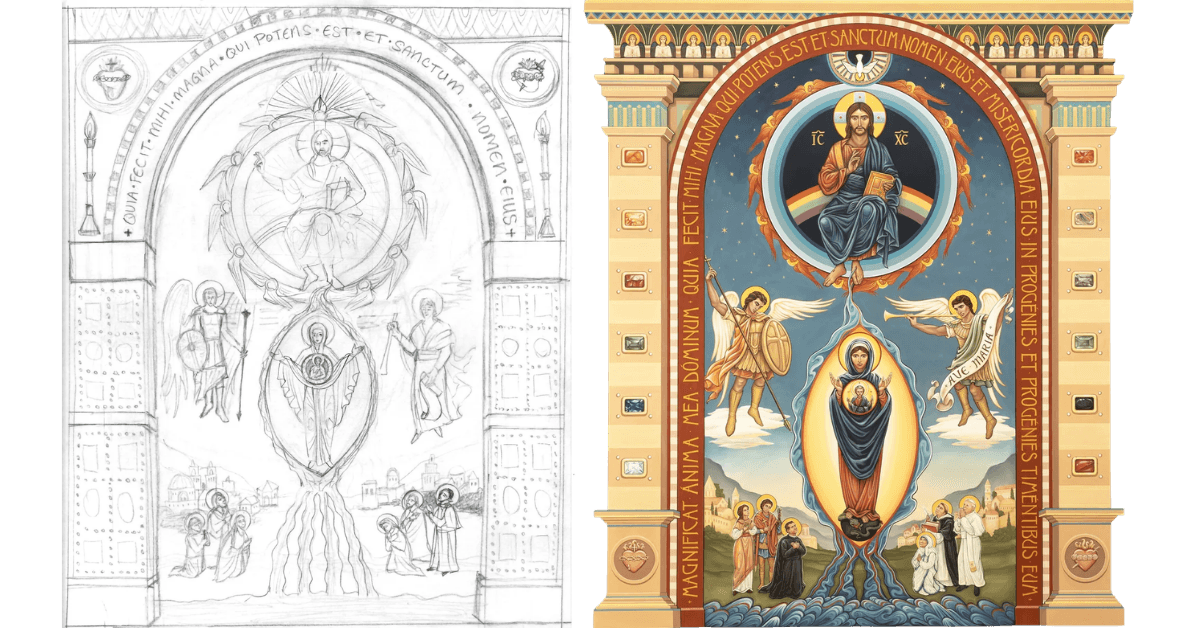
(One of Ruth's hand sketches compared to the final piece: Christ in Glory and Mary, Theotokos, an 18'x14' free-hanging mural at Marian Catholic High School, Woodstock, IL. Photos courtesy of New Jerusalem Studios LLC)
Ascension's Liturgy of the Hours Project
PG: Turning attention now to the particular project of the breviary: given the widespread use that Ascension’s Liturgy of the Hours will have, how do you approach the responsibility of shaping the visual imagination of the Church at that scale?
RS: When I think about the magnitude of the Liturgy of the Hours project, the reach and scope, and all the faithful who will be praying with these images I am creating, I approach the process with great fear and trembling!
But at some point, I have to lay all that aside and get to work, trusting that “He who began a good work in me will bring it to completion.”
I stay grounded by reminding myself of the most fundamental goals—to share my love and joy for this beautiful and ancient prayer of the Bride of Christ, to reveal the text so one can enter more deeply into the Word, and to remember that it is ultimately God’s work, not only my illustrations, but the Liturgy of the Hours overall, and we are participating in it. I have prayed my way through the process, received much counsel, both theological and spiritual, and I trust the excellent and faithful team at Ascension to bring this to fruition so that it is both beautiful and impactful for generations to come.
PG: Without getting into specifics prematurely, are there particular themes or principles guiding your work on this project?
RS: The prayer of the Church in the Liturgy of the Hours is so ancient. My aim is simply to receive from tradition and not introduce novelty, from which the Church has suffered in the past. I have drawn from ancient mosaics, iconography, Byzantine art, and medieval illuminated manuscripts. I have also been inspired by symbolic motifs and patterns from all over the world, as long as they are timeless and add to the theological meaning of the work.
In terms of composition, I rely on the principles of sacred art that I have learned and practiced in my murals and church installations. The same principles apply, but in a black and white format—much more focused, concise, and impactful.
PG: In this project or in others, have you found yourself fostering particular devotions to any saints because of your work?
RS: I ask for the help and intercession of each saint I am painting at the time. But I often pray to St. Anthony, who never ceases to help me, St. Therese, who understands the value of being little and doing little things with great love, and St. John Paul the Great, who revealed the artist’s heart to the Church. I also love St. Joseph, who is such a great father and provider, and “Terror of Demons”, while being quiet, gentle, and unshakable.
PG: What a wonderful cast of holy helpers! Thank you so much for joining us, Ruth. Best of luck in your continued work.
Thank You!
We’re grateful to Ruth Stricklin of New Jerusalem Studios for taking the time to share her work and perspective with us. Be sure to keep an eye out for her contributions to the forthcoming Liturgy of the Hours from Ascension Press, where her work will continue to shape the prayer and sacramental imagination of the Church.
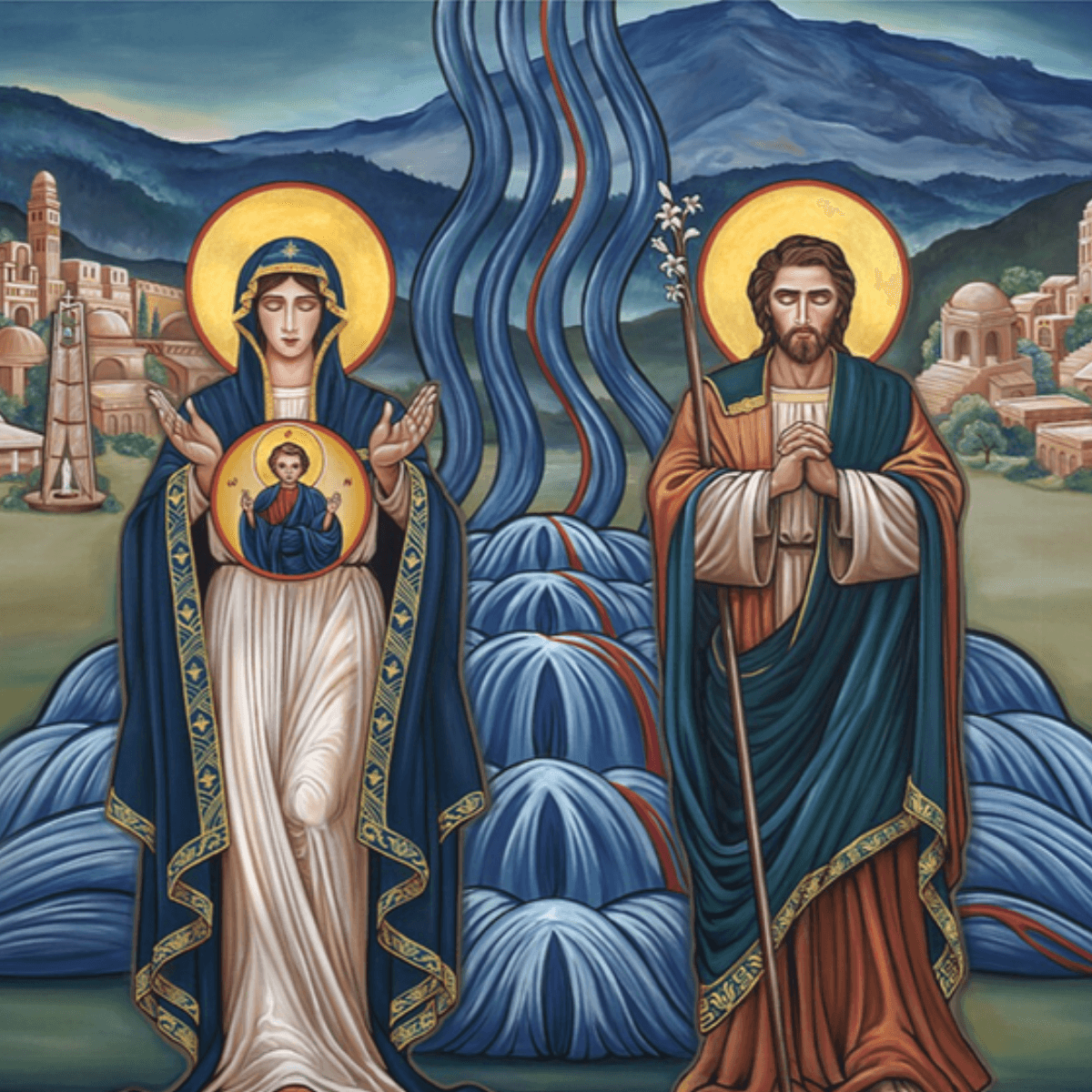
(Top Image: Duc in Altum, 15’ x 18’ mural on canvas, detail, cropped by Source & Summit. Copyright Ruth Stricklin, New Jerusalem Studios LLC. Courtesy of artist.)